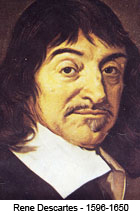
Descartes’ Dictum
“I Think, therefore I Am”
or
“It is indubitably true that I exist”
Descartes’ (and Augustine’s) famous dictum “The only secure knowledge is that I exist”,
the cogito, which assumes the infallibility of self-consciousness, is without foundation. Our only assurance that we exist is because we believe in Jesus Christ when He declares that He created us, and that faith is a gift. (John 5:46)
Am I certain that I exist? Yes. Can I prove it? No […] Our existence cannot be demonstrated […] we have no clear and strong consciousness of it that it leaves us no uncertainty; but it is impossible to prove by reasoning.
Rev. James Balmes; (1810-1848);
Fundamental Philosophy; 1847/1856; p105
 […] what Descartes’ insight establishes is very limited.
First,
the cogito is essentially first-personal – my cogito only works for me, yours only for you; it is certainly not beyond the demon’s powers to fool me into thinking that
you are thinking (and therefore that you exist).
Second,
the cogito is essentially present-tense:
it is perfectly compatible with it that I cease to exist when I am not thinking.
Third,
the ‘I’ whose existence is established is extremely attenuated and elusive: I may have none of the biography and other attributes that I believe make me
me, and indeed I may still be completely in the clutches of the deceiving demon.
Ben Dupré; 50 Philosophy Ideas; 2007; p17
 […] for [Descartes], God and the world were problems, but he himself was not.
R. Rushdoony; (1916-2001);
By What Standard?; 1974; p8
[…] for [Descartes], God and the world were problems, but he himself was not.
R. Rushdoony; (1916-2001);
By What Standard?; 1974; p8
 First of all I say that Descartes begs the question. For the question is
whether he exists, and rightly so, for he who wishes to doubt all things
must doubt whether he exists, just as Democritus avowed that he had done.
Then, to prove that he exists, he says: “I am thinking, therefore I am.” But
what is that ‘I’? if not some thing that exists.
He asks whether he exists
and assumes that he exists.
He thus assumes as granted what is being
questioned. What then is this ‘I am thinking’ [Ego cogito]? It is this: I am
(a thing that is) thinking [Ego sum cogitans]. From this the following
argument is produced: I am (a thing that is) thinking, therefore I am. This
argument reduces to that of Chrysippus: “if it is day, it is day;” or, “it
is day, therefore it is day.” If I exist, I exist; or, I am, therefore I am.
I thereby assume the “I am” in order to prove that I am, and I argue in a
vicious circle […]
Pierre-Daniel Huet; (1630-1711);
Against Cartesian
Philosophy; 1689
First of all I say that Descartes begs the question. For the question is
whether he exists, and rightly so, for he who wishes to doubt all things
must doubt whether he exists, just as Democritus avowed that he had done.
Then, to prove that he exists, he says: “I am thinking, therefore I am.” But
what is that ‘I’? if not some thing that exists.
He asks whether he exists
and assumes that he exists.
He thus assumes as granted what is being
questioned. What then is this ‘I am thinking’ [Ego cogito]? It is this: I am
(a thing that is) thinking [Ego sum cogitans]. From this the following
argument is produced: I am (a thing that is) thinking, therefore I am. This
argument reduces to that of Chrysippus: “if it is day, it is day;” or, “it
is day, therefore it is day.” If I exist, I exist; or, I am, therefore I am.
I thereby assume the “I am” in order to prove that I am, and I argue in a
vicious circle […]
Pierre-Daniel Huet; (1630-1711);
Against Cartesian
Philosophy; 1689
 To
say “I think, therefore I am” isn’t really to prove existence from thought, since to think and to be thinking are one and the same, and to say
I am thinking
is already to say
I am.
To
say “I think, therefore I am” isn’t really to prove existence from thought, since to think and to be thinking are one and the same, and to say
I am thinking
is already to say
I am.
[…] only God can see how the two items
I
and
existence
are connected […]
Gottfried Wilhelm Leibniz; (1646-1716);
New Essays on Human Understanding; 1705/2005; tr. J. Bennett; bIV; c7; p206
 No existential proposition of any sort seems discoverable, […] not even
the famous “cogito” is indubitable.
No existential proposition of any sort seems discoverable, […] not even
the famous “cogito” is indubitable.
G. E. Moore;
The Nature of Judgment;
Mind; 1899; p191
If reason throughout all time before
Descartes bore only doubt, we must conclude that it was a faculty
whose intrinsic nature it is to doubt. If reason, then, is
intrinsically a faculty of doubt, Descartes contradicts what seems
to be his trust in the capacity of reason to bring forth certainty
[…]
he ought to have doubted, were he logical, the capacity of his
reason to reach truth and certainty.
Michael J. Mahony; Cartesianism; 1925;
p39,40
Descartes’ procedure is to employ doubt methodologically: the
dubito becomes his criterion for
judging the credibility of an idea. In particular, the belief in his personal existence follows, he holds, from the uncompromising
application of the standard of doubt to all beliefs. Yet Descartes’ inability to find a single belief which he cannot doubt itself
provides him with one, for it informs him vividly of the fact of his doubting, the only fact which he cannot doubt. Hence his conclusion.
Yet, in a particularly subtle way, this procedure commits a petitio principii. For Descartes’ proof of his existence as a doubting, and thus a thinking, being follows, not from his
use of the method of doubt, but from his adoption of that method.
[…]
For Descartes began with something he could not doubt — his resolve to doubt. Therefore, his conclusion was not the result of applying the method of doubt; it was the consequence of his decision to adopt it. There being a doubter follows from the decision to doubt and not from the doubting, itself.
Arnold Berleant;
On the Circularity of the Cogito; 1966
 In
a sense, Descarte’s insight is not generalizable. […] Each of us can
formulate “for himself” […] the Cartesian sentence ego sum, ego
existo. But since its indubitability is due to a thought-act which
each man has to perform himself, there cannot be any general
sentence which would be indubitable in the same way without being
trivial.
In
a sense, Descarte’s insight is not generalizable. […] Each of us can
formulate “for himself” […] the Cartesian sentence ego sum, ego
existo. But since its indubitability is due to a thought-act which
each man has to perform himself, there cannot be any general
sentence which would be indubitable in the same way without being
trivial.
Jaakko Hintikka; (1929-2015); Cogito, ergo sum:
Inference or Performance?;
The Philosophical Review; 1962; v71;
n1; p21
Begging the question
From Wikipedia
In
classical rhetoric and logic, begging the question or assuming the
conclusion
is an
informal fallacy
that occurs when an argument’s premises assume the truth
of the conclusion, instead of supporting it.
For
example, the statement “Green is the best color because
it is the greenest of all colors” claims that the color
green is the best because it is the greenest— which it
presupposes
is the best.
It
is a type of circular
reasoning: an argument
that requires that the desired conclusion be true. This
often occurs in an indirect way such that the fallacy’s
presence is hidden, or at least not easily apparent.
Formal and Informal
Fallacy:
In philosophy, reasoning that fails
to establish its conclusion because of deficiencies in
form or wording.
Formal fallacies are types of
deductive argument that instantiate an invalid inference
pattern; an example is “affirming the consequent: If A
then B; B; therefore, A.”
Informal fallacies are
types of inductive argument, the premises of which fail
to establish the conclusion because of their content.
There are many kinds of informal fallacy; examples
include argumentum ad hominem (“argument against the
man”), which consists of attacking the arguer instead of
his argument; the fallacy of false cause, which consists
of arguing from the premise that one event precedes
another to the conclusion that the first event is the
cause of the second; the fallacy of composition, which
consists of arguing from the premise that a part of a
thing has a certain property to the conclusion that the
thing itself has that property; and the fallacy of
equivocation, which consists of arguing from a premise
in which a term is used in one sense to a conclusion in
which the term is used in another sense.
Britannica.com
…
The phrase begging the question originated in the 16th
century as a mistranslation of the Latin petitio principii, which in turn was a mistranslation of
the Greek for “assuming the conclusion.”
The Cogito is based on faith in one's
own self. Faith in a fallen, always fallible human mind, can
never lead to the acquisition of truth.
[4/5/21]


