The use of numeric values of Biblical words and phrases in the original languages as a possible additional source of increasing our knowledge of
God’s revelation is shown to be a bankrupt endeavor. The methods used by Theomaticists are demonstrated and critiqued. The end result is a refutation of a modern revival of numerology.
 Numerology has an ancient history. Numbers have fascinated men since their invention and Bible believers have not been immune from their mystical influences.
I was introduced to the work of Ivan Panin as a young boy, and felt that there must be some validity to Bible Numerics. Years later, as an engineering student, I heard of a young man doing research in Bible Numerics. I contacted that person and met with him for several days, discussing his new method of discovering numeric features and his need for tools for further research.
Soon after, I was able to obtain the text of the New Testament in Greek on computer tape, from the Battelle Memorial Institute, through the generous help of the late Dr. J. Arthur Baird (d. 1994). The institute had created a digital (ASCII) format of the Greek NT based on the Nestlé text. To my knowledge, the Old Testament in Hebrew had not yet been digitized. Over the next two years and with the help of an expert programmer, we were able to produce the following tools:
Numerology has an ancient history. Numbers have fascinated men since their invention and Bible believers have not been immune from their mystical influences.
I was introduced to the work of Ivan Panin as a young boy, and felt that there must be some validity to Bible Numerics. Years later, as an engineering student, I heard of a young man doing research in Bible Numerics. I contacted that person and met with him for several days, discussing his new method of discovering numeric features and his need for tools for further research.
Soon after, I was able to obtain the text of the New Testament in Greek on computer tape, from the Battelle Memorial Institute, through the generous help of the late Dr. J. Arthur Baird (d. 1994). The institute had created a digital (ASCII) format of the Greek NT based on the Nestlé text. To my knowledge, the Old Testament in Hebrew had not yet been digitized. Over the next two years and with the help of an expert programmer, we were able to produce the following tools:
1-
A Computerized Interlinear Numeric-Greek New Testament
based upon the traditional numeric values of the Greek alphabet. The numeric value of each word was calculated by computer.
[This work was recognized as unique and unprecedented, and
was featured on the CBS nationwide radio program,
Speaking of Religion.]
An example from the Interlinear Numeric-Greek NT, from John 1:1 –
|
55
|
709
|
58
|
70
|
373
|
|
εν
|
αρχη
|
ην
|
ο
|
λογος
|
The traditional numeric values of the Greek alphabet are:
(Upper case, lower case = Numeric value)
|
Α, α = 1
Β, β = 2
Γ, γ = 3
Δ, δ = 4
Ε, ε = 5*
ς
= 6**
Ζ, ζ = 7
Η, η = 8
Θ, θ = 9
|
Ι, ι = 10
Κ, κ = 20
Λ, λ = 30
Μ, μ = 40
Ν, ν = 50
Ξ, ξ = 60
Ο, ο = 70
Π, π = 80*
|
Ρ, ρ = 100
Σ, σ, ς
= 200
Τ, τ = 300
Υ, υ = 400
Φ, φ = 500
Χ, χ = 600
Ψ, ψ = 700
Ω, ω = 800
|
*The reason that 6 & 90 do not appear in this list is because some characters in the Greek alphabet became obsolete and were deleted from the alphabet.
**Most Greek manuscripts of the Book of Revelation spell out the number of the Beast in Rev. 13:18 as “Six-hundred Sixty Six.” One known Greek manuscript (p47, see the blue
box below) records the number of the Beast using the three lower case characters
χξς
which represents 600+60+6. From this we can surmise that the final sigma
ς
sometimes took on a value of Six, even though it would place the
letter out of alphabetical order. This feature is available only when the manuscript is written in Lower Case letters, e.g.
ιησους.
Some manuscripts are written in Upper Case, CAPITAL letters only. In that case there is no difference between Mid
and
Final
Sigmas, e.g.
ΙΗΣΟΥΣ.
It is likely that since the letter that stood for the number
“six” had become obsolete, that Greek writers used the only Greek alphabetic symbol (glyph) that was available as a substitute, the final
ς.
A page from the p47 manuscript containing Revelation 13:16 to 14:4.
Lines containing “666” and “144” are pointed out.
A Bar over the letters designates an abbreviated
word.
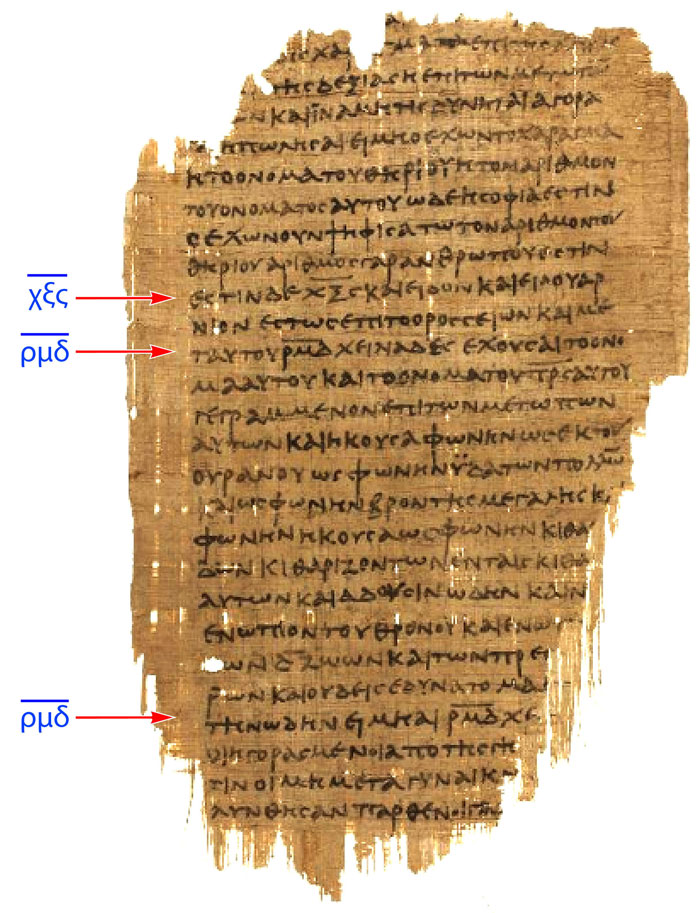
Theomaticists highlight the fact that p47, a very early manuscript, uses Greek letters to represent numbers. (The
144
thousand in Rev. 14:1 is given as
ρμδ.)
This fact, which is not controversial at all and is a feature of other ancient
languages, is used as a justification for their numeric endeavors. At the same
time, they ignore the fact that this same example shows that the letter sigma
σ, ς
can have more than one numeric value. This is because they want the numeric value of Jesus
(ιησους)
to equal to 888. If they substituted the number ‘6’ for the final
ς
as would be required by this manuscript evidence, instead of the number ‘200,’ then the numeric value of Jesus would become 694, and that does not look as “awesome” as 888.
The fact that the Lower case Sigma can have two different numeric values depending on its location in the word, places the basis of Theomatics further into doubt because it is founded upon the assumption that the numeric values of the letters of the Greek alphabet are fixed and incontrovertible.
All modern calculations in Bible Numerics and Theomatics are in contravention of this manuscript evidence because the final Sigma is always given a numeric value
of 200 instead of a value of six (6).
The numeric value of a word is determined by adding the numeric values of each letter in the word. e.g. the Numeric Value of the Greek word
Logos, usually translated as “Word” is
λογος
= 30+70+3+70+200 = 373
Two other volumes of the Interlinear Numeric Greek New Testament were also produced, each one based upon a different Random Number assignment for each Greek character; e.g. instead of a value of 1 for
α,
it had a value of 200. This was done to see if numeric “features” were still present with Random Values. To my knowledge, this work was not adequately
investigated.
2-
An Alphabetic list of every word in the Greek NT.
3-
A Numeric Value list of every word in the Greek NT.
4-
Tables listing every number from 1 through 21000, giving each number’s Prime
Factors
and all of its Plain Factors. A small part of this document is
reproduced in the maroon box below.
For example:
The Prime Factors of
888 are: 2x2x2x3x37;
The Plain Factors of 888
are: 4,6,8,12,24,74,111,148,222,296,444.
The Prime Factors together with all of the Plain Factors are all of the numbers that divide evenly into 888 leaving no remainder. One way to determine the Plain Factors of a number is to multiply the
Prime Factors in all possible unique combinations:
e.g. 2x2=4, 2x3=6, … 2x3x37=222 etc.
The Bible numericist’s goal is to find Prime or Plain Factors that are in common between the numeric values of two or more doctrinally significant words or
phrases, to be able to conclude that:
1- The existence of these common factors is “scientific proof” that the Bible is inspired by God, because such
numeric features could exist only if they were devised by a supreme mind.
2- If there is an ambiguous Biblical passage, its uncertainty can be eliminated if the numeric value of the first passage has a common factor with the
numeric value of another Biblical word or phrase whose meaning is certain.
Bible numerology can be divided into two categories: the method of Ivan Panin,
usually called Bible Numerics, and its more recent reincarnation that has been
given the moniker Theomatics. Other methods that purport to discover letter
sequences with prophetic pro-gnostications, but which turn out to be
retro-gnostications, can be safely ignored.
Simply put, the difference between Ivan Panin’s Numerics and that of
Theomatics is the magnitude of the number that is accepted as a “feature”
(Panin) or a “hit” (Theomatics). Ivan Panin considered the “discovery” of
numeric values of one or more words which are multiples of the number seven
(7), to be a statistically significant occurrence. Theomaticists minimize
Panin’s work, and justifiably so, because a numeric value that is a multiple
of seven is statistically insignificant, since every seventh number is a
multiple of seven. The Theomaticist’s preference is that a word or
phrase should exhibit a numeric factor that is greater than 100,
although lesser numbers are still accepted when higher values are
unattainable. Numeric features of magnitude 100 or greater would be
considered to be statistically more significant than features that are
multiples of the relatively small number of seven (7).
But this creates a dilemma
for the Theomaticist. The numeric values of a significant portion of the
words in the Bible are less than 500. This makes it difficult to “discover”
common factors, i.e. “hits” with magnitudes of values over 100. Thus the
Theomaticist is forced to add the numeric values of several neighboring
words in proximity to the keyword in order to produce sums of several
thousand, so that factors greater than 100 may become available to him. A
keyword is the word carrying the essential spiritual message in a sentence.
Examples are light, fish, water; words which have both literal meanings and
important spiritual connotations. The meanings of the neighbor words usually
have no relation to the meaning of the keyword.
They simply complete a thought or are necessary for forming a meaningful
sentence. The Theomaticist has now been put into a position where he finds
it necessary to add the numeric values of two or more diverse words to help
him find “hits” which he considers statistically significant.
In this Critique, I will use the terms Numerics and Theomatics interchangeably
where applicable.
A shroud of mystery surrounds the work of those who are “discovering” numeric “features” because the detailed steps to “discovery” are not plainly
evident. I will attempt to uncover the mystery.
The Theomaticist is
interested in the pairing of large numeric values to Biblically/spiritually
significant key words. As mentioned previously, most biblical words have
relatively small numeric values, therefore the numericist has no choice but
to add the numeric values of one or more words which are in proximity to the
key word, to obtain large sums with large factors. But the process of
“discovery” is compromised right from the start because the selection of the
beginning and end of a phrase is left to the discretion of the numericist.
He decides where to begin and end each phrase or group of words, how many
words to include in the phrase, and even to remove (and add) words or
characters occurring within the phrase, because he deems certain words
unnecessary to the meaning of the phrase. He feels free to ignore certain
words in the text, such as articles, prepositions, etc., which he feels are
unimportant and even meaningless. Since word order is different in Greek and
English, he feels free to rearrange word order. Stilted phrases, almost
meaningless word groupings, abound in Theomatic calculations even though the
Theomaticist assures us that he has chosen the words “exactly as they appear
in the text.”
Since there is always some
nuance in every sentence, this might seem reasonable at first sight. After
all, it is still understandable when one says Water is wet instead of
The
Water is wet. The meaning of both sentences is close enough under most
circumstances, but they are not identical. The numericist feels free to drop
or add the article The, (i.e. its equivalent in Greek) and attempts to find
Numeric Features in the sentence with or without the article. Even a basic
intuitive understanding of the nature of probability should arouse concern.
Such flexibility in the selection of word combinations places numerics
outside the realm of repeatable and testable science.
The theomaticist is unaware that such a small manipulation in a phrase can
create many new possibilities for “Hits”!
An example will help to clarify the procedure:
Let us say that the
theomaticist has calculated that a phrase has a numeric value of 2082. The
Prime Factors of 2082 are 2x3x347 (see list below), and its Plain Factors
are 6, 694 & 1041. Only these six numbers divide evenly into 2082: 2, 3, 6,
347, 694 & 1041. The small values, such as 2, 3 & 6 are not considered to be
statistically significant.
This is disappointing to the
numericist because he has so few factors with which to compare with values
from other phrases. What does he do? On the table of Prime and Plain Factors
(see below) he looks up and down the list to find a number which varies a
few or more digits from 2082, but which has
more Factors.
Even more perversely, he may go directly to a number that contains the “Hit”
value that he is looking for. He manipulates the original phrase so that its
numeric value decreases or increases. He removes a letter or two or a word
or two, from the phrase, which he arbitrarily calls “meaningless or
unnecessary,” and ends up with a phrase, of say, Numeric Value 2080. (The
value could be much higher or lower, as long as it “produces” the “hit”
value that he is after.)
Now, the Prime Factors of 2080
are 2x2x2x2x2x5x13 (see below); and its Plain Factors are: 4, 8, 10, 16, 20,
26, 32, 40, 52, 65, 80, 104, 130, 160, 208, 260, 416, 520 & 1040. These are
Twenty-One NEW Factors (2 is common to both), giving a Total of Twenty-Seven
Factors with which to work, whereas before he had only Six factors. The
possibilities for finding a “hit” that could be “related” to other phrases
has increased dramatically. In fact the possibilities of a “hit” have
multiplied by over
Four times!
Let’s say that the numericist is not satisfied with these choices. All he needs to do is add a
letter or two or more from a word before or after the phrase found in the Bible, and now the numeric value of the phrase is 2088, just 6 points above
the original value
…
(continued after
Table of Numbers)
 Ivan Panin, the most prominent person in Bible numerics in modern times, was born in Czarist Russia in 1855, lived most of his life in the US, and died in Ontario, Canada in 1942. He received an A. B. degree in Literature from Harvard University in 1882. Contrary to online claims, Panin was not a mathematician, he did not tutor Einstein, nor was he awarded a Doctorate degree.
He was a contemporary of the influential Harvard professor Benjamin Peirce (pronounced Purse) (1809-1880) and his son the philosopher Charles Sanders Peirce (1839-1914), for both of whom mathematics was the infallible mode of access into the “mind” of God, which is a completely unbiblical notion. At a time when it was becoming clear to those in the know that mathematics was a human invention, and that the foundations of mathematics were not only uncertain but inconsistent, Ivan Panin expended great efforts in trying to link numbers with God.
(see page: There is no truth in numbers.)
 Ivan Panin is interred at Mt. Pleasant Cemetery in Toronto, Ontario, Canada.
Panin hoped that by demonstrating the mathematical “foundations” of the Scriptures, leaders in academia might be won over to its message.
It is important to mention that in October 1887, five years after Panin graduated from Harvard, but three years before he was converted to Christ, F. W. Grant (1834-1902) published a book entitled, The Numerical Structure of Scripture. (ISBN 0-87213-269-2) There Grant divides and subdivides the Bible into five-part sections, using the first five books of the Old Testament as his model. Grant further divides the text into groups of verses, based on the mistaken notion that the chapter and verse designations in the Bible are a part of the inspired text.
In 1890, the same year that Panin became a Christian, and the year in which he claims to have discovered “unparalleled numeric phenomena of the Bible,” Grant began to publish
The Numerical Bible, a seven volume commentary on most of the Biblical books. There he begins to assign meanings to numbers after acknowledging the fact that the chapter and verse divisions are a “human contrivance.”
On page 125 of his commentary on Genesis, he notes the following:
“[Jacob] dies at a hundred and forty-seven years old,– a number not without meaning, we may believe, in its 7x7x3, the number of complete accomplishment intensified[…]”
Here were planted the seeds of modern Numerics and Theomatics.
The idea that numbers have God as their source (Platonism) is ancient. But it took on a life of its own when Descartes (1596-1650) cited the apocryphal book
Wisdom of Solomon as justification for the grotesque belief that numbers are eternal entities. The citation is found in 11:21, “thou hast ordered all things in measure, and number, and weight.”
(See also Job 28:25 and Isa. 40:12. See the other pages under the Nature of Numbers topic for more information.)
Simultaneously, the error was further entrenched by Galileo’s (1564-1642) audacious proposal that it was impossible to know God and of His acts in
creation without an intimate knowledge of mathematics and geometry. The prestige of these and other prominent men since their time has added an aura of
invincibility to mathematics in the minds of those unfamiliar with the nature of numbers. This monstrosity of human “wisdom,” in conjunction with modern
technical achievements, continues to threaten the Church’s autonomy and its monopoly on Truth.
If the numericist is having difficulty finding a “hit” for a phrase which he feels it “should” have, and if the original Greek text is inflexible and does not allow for adding or subtracting of an “unnecessary” word, the theomaticist arbitrarily assigns a numeric value to the phrase, and helps himself to the idea of “clustering,”
which is a euphemism for “margin of error.” The symbol for clustering
(=margin of error) is given as a tiny tick mark (') after the phrase. The
explanation for the tick mark is given in the introduction, hidden from most
people’s eyes.
WHY PANIN’S BIBLE NUMERICS IS INVALID AND UNSCIENTIFIC
1- The selection of the length of texts is arbitrary and unrepeatable.
2- Word numeric values being multiples of seven, a very small number, have no significance in statistics and probability.
3- Non-Biblical texts exhibit the same numeric
“features” as those found in Scripture.
4- Numeric
“features” are present in texts of languages other than Koine Greek
and Biblical Hebrew.
5- The concept of
“neighborhood” (=clustering) is tacit admission that numerics is null and void.
6- The attempt to establish the text of the autographs in Koine Greek, based upon Bible numerics, has been a failure.
7- The method of Textual Criticism will always take precedence over Bible numerics in trying to establish the text of the autographs.
By adding to or subtracting from the phrase’s numeric value, he shifts the numeric value of the phrase up or down to a new “neighbor” value.
The direction of the shift, with its adverse and invalid probability implications, is never given. In this way the numeric value of the phrase acquires a “hit” which it did not originally exhibit. The theomaticist forces a numeric value upon a phrase to make it “fit” a presumed value. Ivan Panin also counted on a margin of error for producing his features, but he called it “neighborhood.”
Relying on a margin of error of as much as ±3 points is touted as positive support for the validity of Theomatics, when in fact
it is powerful evidence that numerics does NOT work. The Theomaticist’s own statistics show that most of the “phrases” do NOT produce “hits.”
A 1998 publication called The Original Code in the Bible was recently examined. A manual count was done of all the features presented in the book and classified according to category of “hit.” Several examples of the stilted phrases and incomplete thoughts on which the “hits” are based were noted. Even after the heroic contortions in manipulating phrases, the Theomaticist’s own results show that over Two out of Three features are NOT “hits.” A PDF file of the results of this brief study can be seen
here.
TABLE OF NUMBERS & FACTORS
Below is a partial list of numbers, and their Prime and Plain Factors:
…
2080
= 2x2x2x2x2x5x13
Plain Factors> 4, 8, 10, 16, 20, 26, 32, 40, 52, 65, 80, 104, 130, 160, 208, 260, 416, 520, 1040
2081
= 2081 (a prime number)
2082
= 2x3x347
Plain Factors> 6, 694, 1041
2083
= 2083 (a prime number)
2084
= 2x2x521
Plain Factors> 4, 1042
2085
= 3x5x139
Plain Factors> 15, 417, 695
2086
= 2x7x149
Plain Factors> 14, 298, 1043
2087
= 2087 (a prime number)
2088
= 2x2x2x3x3x29
Plain Factors> 4, 6, 8, 9, 12, 18, 24, 36, 58, 72, 87, 116, 174, 232, 261, 348, 522, 696, 1044
2089
= 2089 (a prime number)
…
21000
= 2x2x2x3x5x5x5x7
…
The Prime Factors of 2088
are 2x2x2x3x3x29; (see above) and its Plain Factors are: 4, 6, 8, 9, 12, 18, 24, 36, 58, 72, 87, 116, 174, 232, 261, 348, 522, 696 & 1044. These are another Seventeen NEW Factors which the numericist is more than happy to juggle for features. 2, 3, 4, 6 & 8 are factors that the numbers have in common.
Adding up all of the Unique Factors for just these three combinations of phrases with values of 2080, 2082
and
2088, we come up with Forty-Four different factors that can be used to “discover” numeric
features or “hits,” a much larger value than the 6 numbers that were originally available. If we disregard all values less than 100 as
being statistically insignificant, we still end up with 19 unique numbers that can be used to “discover” numeric features. Compared to the
original 3 significant Factors, now there are over 6 times as many factors that are greater than 100 with which to work.
One does not have to be a statistician to realize that this is not a valid method in probability.
The numericist makes a similar effort using words from another phrase which he deems has a similar
meaning to the first phrase. If he “discovers”
one
Common Factor between the two sets of factors, then he declares that he has found a “Hit.”
The example given was for a phrase with a relatively low value of 2082 for
its numeric value. It can be shown that the greater the numeric value of the
phrase, the greater the number of factors and the greater the possibility of
“hitting” upon the “right” value that “proves” to the numericist that there
is a pattern there. The presence of this pattern “proves” to him that the
Bible was inspired by God and assures him of the real meaning of the
phrases.
In addition to the flawed mathematical techniques on which Theomatics is based,
there are serious philosophical difficulties which it cannot surmount.
I- Theomatics is based upon an erroneous assumption.
The assumption is that the Numeric value of a WORD
can stand in place of– or is in some way related to– the MEANING
of
that word.
In other words,
a WORD is confused with the MEANING that the word denotes or connotes.
It is not difficult to show that the meaning of a Word is NOT in the combination of its letters nor in the sound that is associated with that group of letters.
The meaning of a word is a thought evoked in the mind of the hearer.
For example: There are at least as many words for “water” as there are languages. “Nero” in Greek, “Choor” in Armenian and “Mayim” in Hebrew, all mean
“water.” They are completely different Words with completely different alphabets and pronunciations, but they all MEAN the same thing. Speakers of each language have chosen to refer to “water” using, what in the final analysis is, an arbitrary set of symbols and sounds.
[…] it is meanings and not sounds that constitute the essence of language.
Hunter Mead; Types and Problems of Philosophy; p165
To calculate the numeric value of a
Word
and then assume that one has found the number which represents the Meaning of that word is the colossal error
upon which Theomatics is based.
II- Words cannot be
converted into numbers and then be expected to reveal more
knowledge than is already there IN THE WORDS.
Numbers by themselves carry No meaning, meaning
that is needed to convey information from person to person. A “sentence” such as
(281 38 415, 1 66 84 131 6.) is meaningless. It cannot be called a sentence,
because sentences must have words in them, because only words carry meaning.
Numbers are tools like hammers and computers, and their substitution in place of words is illogical and unfruitful.
Words are too rich an entity to be reduced to numbers and still retain their integrity.
Terms
that are names of numbers, e.g., One, Two, Thirty-three, are Tags which
can be represented by or replaced with symbols such as 1, 2, 33, etc.
Any symbol can be used to represent a
number term as is evident by the use of Roman Numerals: I, II, XXXIII, or
lower case letters such as i, ii, xxxiii. These symbols are a shorthand
way of representing number terms.
Then, working in reverse, when we
see the symbol “1”, we read it with the name; “ONE.” The name “One” and
the symbol “1” are interchangeable.
In contrast, a term with a
rich meaning might be converted into a number, but the number loses the
link with the original word’s meaning. If the word “Love” is converted
into its numeric value, which is 495, the number 495
cannot be read back or understood as meaning “Love”!
Words and sentences have subtle
meanings that numbers can NEVER convey. Meanings and definitions of words have
hazy boundaries. Meanings of words are not Black and White entities. Unlike
words though, numbers have clear boundaries. They are Black and White concepts.
Numerics is a futile attempt to force Black and White boundaries upon words with
unfocused meanings. Such attempts are unfeasible and unattainable.
III
- By converting words into numbers, one
does not
add more meaning & information to the Revelation that is already given, but meaning is removed from the words.
Theomatics is an attempt to derive more
information from the Biblical text, but the problem is that by reducing
words to numbers, one is “distilling the fluid” but then discarding the
desirable nectar (the meanings of the words) and retaining the useless vapor
(the numbers). Converting words to numbers REDUCES Revelation and does not increase it. The numericist is diverting people’s attention away from the
meanings of the words in Scripture, and looking into numbers for meanings
which they cannot convey. The inescapable conclusion is that the use of
numerics and/or Theomatics up to this point has been Anti-revelation.
IV- The numericist has NO CHOICE but to start with MeaningFULL
Words,
determine relationships between phrases using these meanings, and finally,
allegedly derive a numerical relationship between these phrases. But the
relationship of the words was ALREADY KNOWN before any numerical conversions
were done. If numerics was a legitimate method of arriving at a fuller
understanding, then the numbers on their own should be able to tell us what
a phrase or sentence means; but of course that is an impossibility.
V- Numericists do not take into account
the fact that the same word can have very different meanings depending on
the context.
To give only one numeric
value to a word is to turn a blind eye to the actual meaning of the word in
its context.
The problem is
further complicated by the fact that in Biblical Hebrew most vowels are not
part of the text. That is, the same set of consonants is pronounced
differently and can have very different meanings based purely upon the
context of the word. To give only one numeric value to such a set of letters
is tacit but unavoidable admission that numeric values of words have no
relationship to their meanings.
Solely due to this fact, Theomatics cannot be taken seriously.
VI-
Theomaticists try to assure us
that the numeric values that are associated with the meanings of words are based upon and derived from the text of the Bible, and insist that the text itself must determine the “meaning” of a number.
But how can one decide if a given number stands for a certain “meaning” when
there are numerous unrelated words in the original text which have the identical numeric value?
For example, the numeric value of 888 for “Jesus” is regarded as unique and of ominous significance, but it is not disclosed to the reader that there are at least 14 other words in the Greek New Testament with a numeric value of 888, each of which has nothing in common with “Jesus” or with each other.
Theomaticists see significance in the numbers:
111 (7 different words have this value),
153 (6 different words),
37 (3 different words),
273 (7 different words),
666 (17 different words),
694 (8 different words), and on and on.
If a common numeric factor between the
numeric values of two or more words or phrases is a sign of a close
relationship between the meanings of those words, then surely the
actual numeric value of a word should be the most important numeric
property of that word. Then it would not be unreasonable to expect that
each word should have a unique numeric value, thus assuring us of a
clear relationship between the meaning of a word and its numeric value.
But in reality, that is not the case.
Words of very diverse meanings, but having the identical numeric value, are abundant in the Bible.
This guarantees that it is impossible to relate numeric values to word meanings. And
since that is the foundation on which Theomatics is established, we can say without fear of contradiction that Theomatics is built upon a foundation of
sinking sand.
Other writers have tried to assign meanings to the numbers that occur in the Bible, such as 1, 3, 7, 12, 24, 40, etc. But no two writers are ever in full
agreement, they often contradict each other, ascribe multiple “meanings” to one number, and they even designate several opposing concepts to the same number.
These are insurmountable difficulties which makes it impossible to arrive at the “meaning” of any word in the Bible based on its numeric value.
VII- Words that do have the same meaning but which occur in the Old and New Testaments have different numeric values.
This is the case even for personal names and titles such as “God” and “fish.” (“God” in Hebrew is 86, in Greek it is 284. “Fish” in
Hebrew is 17, in Greek it is 153.) Of course these variations are to be expected
because of the differences between the Hebrew and Greek languages. Furthermore,
many personal names are spelled differently by different Biblical writers. These
are incontrovertible proofs that numeric values of words have no relationship to
their meanings.
VIII-
It is completely unjustifiable and meaningless to sum up the numeric values of words of diverse meanings, then assign a new numeric value to the “phrase.”
It is linguistic and mathematical delusion to believe that one can “add” numerically the meanings of two or more words.
IX-
If numeric values of words were actually related to
their meanings, then it would not be unreasonable to expect that the names
of the numbers have the numeric values of their names.
For example: the word “One” would have a numeric value of 1, the word “Two”
would have a numeric value of 2; etc. But that is not the case in either
Hebrew or Greek, reaffirming the fact that meanings of words have no
relationship to the numeric values of the words.
X- The many textual variations
that exist in even the most modern and best approximations to the original autographs, make any form of Bible numerics
fruitless. Panin’s hope of “settling the text” of the Bible using numerics was an exercise in futility.
XI- The number of letters in a selected phrase is arbitrary.
There are no controls on the length of a chosen phrase.
The Theomaticist fails to mention the fact that adding a letter or two to a phrase can radically alter the probability of obtaining a “Hit.”
This ploy places Theomatics outside the domain of repeatable science.
Finally[…]
Theomaticists are constantly teasing their readers with expectations of New revealed knowledge
and greater insight into the Scriptures, but are unable to do so, because it is not possible to do so through the magic of numerics.
No “NEW! Best kept secret” has been discovered through Theomatics.
No one should give credence to Bible numerics, Theomatics or any similar method that alleges to derive new and hidden information from the Scriptures.
Articles, from different perspectives, critical of Numerics/Theomatics are available for download. See the Annotated Bibliography below.
In the case of Numerics, Words are converted into Numbers, with the assumption that these numbers will help us to Extract additional information from the words. This we now know is a futile endeavor. Numerics has not given us ANY new insight into Biblical Doctrines. Meanings of Words CANNOT be converted into numbers and be expected to retain their integrity.
Similarly, the attempt to describe natural phenomena in Mathematical terms, we now know, does Not help us to know the Real nature of things. Reality CANNOT be reduced to numbers, because Mathematics is not connected to anything real. It is an inadequate tool invented by fallible humans, to try and organize and make sense of an unimaginably complex creation. Mathematics cannot be asked to do the impossible. The real world cannot be reduced to numbers, just as the Bible cannot be reduced to numerics.
The parallel between Bible Numerics and the attempt at a Mathematical representation of reality in Numeric form is stunning.
>
The Theomaticist tries to represent the Meanings of Words in Scripture in Numeric Form. He is engaged in
Bible Numerics.
>
The scientist tries to represent the thoughts in his mind, which have arisen from observing nature, in Numeric Form. He is engaged in
Nature Numerics.
>>
The numericist begins with words that are available to him in a book. He does not have to invent or create his words, they have been given to him. His task of numeracy is much simplified.
>>
The scientist’s task is more difficult. He first has to invent his words (convert his ideas into words)– there are no words (or numbers) in nature– and then transform these words into numbers by deriving equations.
>>>
Numericist: Words > Numbers
>>>
Scientist: Experience > Words > Numbers
Their occupations are similar:
1- They are both trying to Represent Ideas using Numbers.
2- Neither one can arrive at any Truth whatsoever because their goals are unattainable.
Those who give credence to Bible Numerics are under the incorrect assumption that Numbers have some magical properties that will help them to discover Secreted information in the Scriptures.
In the case of Mathematics, most people are under the incorrect impression that Mathematical representations of Nature are TRUE and EXACT representations of reality. This invalid conclusion must be completely erased from the minds of people. Until then the purported conflict between “Science” and “Faith” will continue to be used by ignorant and insidious men to mislead, confuse and deceive the uninformed.
The following documents have been examined during the writing of this essay. Titles are given in chronological rather than alphabetical order to display these works from a historical perspective. Older publications are rarely given credit by modern numericists or even mentioned as a possible source of ideas, often characterizing their own works as “NEW Revealed Secrets.”
>> Browne, Henry; Ordo Saeclorum: A Treatise on the Chronology of the Holy Scriptures;
London; 1844. In depth chronological study of Biblical events. The author’s attempt to see patterns in dates by prime
factorization is an early example of Bible Numerics. He cites writers going as far back as the Church Fathers as support for his thesis.
>> Mahan, Milo; Palmoni, or the Numerals of Scripture: A Proof of Inspiration;
D. Appleton & Co., NY; 1863. Cites Browne and
follows in his footsteps; in addition, he begins to assign meanings to the basic numerals.
>>
Grant, F. W.;
(1834-1902) The Numerical Structure of Scripture;
Loizeaux Brothers, Neptune, NJ; 1887; revised 1899; 11th printing 1985. Sees great significance in the number 5, “the Bible is a Pentateuch of Pentateuchs” p71. Begins to stress the meanings that he ascribes to the basic numerals. “Numbers are as powers of the
cosmos” p20. They begin to take on spiritual significance.
>>
Grant, F. W.;
(1834-1902)
The Numerical Bible;
Loizeaux Brothers, Neptune, NJ; 1890-1902; Seven volume commentary on most of the books of the Bible. The title “Numerical”
is misleading. Other than the assignment of multiple and contradictory meanings to about the same 10 numbers at the beginning of each volume, the
author displays little imagination. The commentary itself has very little to commend it.
>>
Grant, F. W.;
(1834-1902)
The Witness of Arithmetic to Christ;
Loizeaux Brothers, Neptune, NJ; 1983; A reprint of the five Appendixes of the Third Volume (Psalms) of The Numerical Bible.
Here the writer tries to ascribe meanings to some numerals.
>>
Smith, W. Taylor; Numbers;
A Dictionary of Christ and the Gospels; 1908; p247; Early evidence of the symbolic interpretation of some numbers found in Scripture.
>>
Bullinger, Ethelbert W.; Number in Scripture: Its supernatural design and spiritual significance;
Kregel Publications, Grand Rapids, MI; 1894/1975. Cites Milo Mahan’s Palmoni in the Preface. Begins to ascribe
meanings to about 45 numbers in Scripture. Bullinger should be given due credit for laying the foundations of modern Bible Numerics. All later claims
to originality and “New Revealed Secrets” are invalid and misleading. Several “features,” including the ones based on 153 Fishes, which have been
flaunted by later writers as God’s New revelations, are plainly evident here, decades before the claims of modern numericists.
(http://philologos.org/__eb-nis/)
>>
Panin, Ivan;
(1855-1942) The New Testament: From the Greek Text as Established by Bible Numerics;
The Book Society of Canada; 1914/1945.
>>
Panin, Ivan;
(1855-1942) Bible Chronology: In Three Parts;
Green & Co, UK; undated, possibly 1923. Panin’s aversion to dating his publications is incomprehensible.
>>
Panin, Ivan;
(1855-1942) Tables of Numeric Values of New Testament Words;
unpublished, undated, typewritten pages with many handwritten notes and corrections, in columnar form.
>>
Panin, Ivan;
(1855-1942) The New Testament in the Original Greek:
The Text Established by means of Bible Numerics; Oxford Univ. Press; 1934.
>>
Panin, Ivan;
(1855-1942) The Shorter Works of Ivan Panin;
Introduction date of Feb. 1934; A collection of writings by Ivan Panin and supporters.
>>
Panin, Ivan;
(1855-1942) Verbal Inspiration of the Bible Scientifically Demonstrated;
Bible Numerics, Aldershot, Ontario, Canada. Undated but with Postscript date of 1937.
>>
Panin, Ivan;
(1855-1942) The Last Twelve Verses of Mark;
Their Genuineness Established; undated booklet.
>>
Hurnard, Samuel F.;
Numerical Witness to Biblical Inspiration;
Jan. 1934, Aldershot, Ontario, Canada.
>>
Anonymous “Rector of an Anglican Church in Canada”; Numerical Witness to
Bible Inspiration;
Aldershot Mimeograph No. 6; undated, possibly during Panin’s lifetime. Repeat of Ivan Panin’s “discoveries.”
>>
Sabiers, Karl G.; Astounding New Discoveries;
Robertson Publishing Co., Los Angeles; 1941. A
small booklet that did much to publicize the works of Ivan Panin. Reprinted in 1969 under the title Mathematics Prove Holy Scriptures; Bible Numerics, Niagara Falls, Ontario, Canada.
>>
Hughes, John P. L.; God Proved by Words and
Figures;
subtitled, ABC Arithmetic Gematria; UK; Undated,
internal evidence places this book after December 1941.
>>
Allis, Oswald Thompson; Bible Numerics;
Presbyterian & Reformed Publishing Co., 1944/1974; A small booklet that exposes some of the fallacies of Bible numerics from a theological perspective. It is available
here as a PDF file.
>>
Stoner, Peter W.; Dr. Ivan Panin’s Work on Bible Numerics;
American Scientific Affiliation Yearbook; 1947; A short article refuting Panin’s work using probability analysis.
>>
Filmer, W. Edmund; God Counts;
1947/1984; Summarizes the work of Ivan Panin.
>>
Smith, D.
David; Gematria and New Masorah of Genesis 1:1;
MicroText; 1949, revised 1963, 1966.
>>
Nobell, Albert; And the Numbers Came: A Brief Look at Number Patterns in Scripture
self-published monograph; 1968. Mr. Nobell and his Nobell Research Foundation were early supporters of Karl Sabiers.
>>
Davis,
John J.; Biblical Numerology: A Basic Study of the use of Numbers in the Bible;
Baker Book House; 1968/1976; A scholarly critique of Bible Numerics. An indispensable book with many valuable references.
>>
Michell, John; City of Revelation: A Book of Forgotten Wisdom;
David McKay Co., NY; 1972. In addition to Bible Numerics, the writer sees patterns in Stonehenge, sacred geometry, the number of fusion, etc.
>>
Kistler, Don; The Arithmetic of God;
self-published, Kings Mountain, NC; 1976. New “meanings” are given to about 60 numbers, some of which are not mentioned in the Scriptures but author
claims that their meanings were “revealed” to him by God.
>>
Lucas, Jerry & Washburn, Del; Theomatics: God’s Best Kept Secret Revealed;
Stein & Day, NY.; 1977, 4th printing 1978. A reincarnation of Panin’s Bible numerics but named “Theomatics ” to try and distance himself from Panin and to claim originality. No credit is given to any previous works on Bible numerics.
>>
Priestley, David T.; Is the Bible Numerically Pure?;
A review critical of Lucas & Washburn’s Theomatics; Christianity Today, March 23, 1979.
>> Ackerman, Paul D.;
A Computer Test of Theomatics; Bible Science Newsletter; Oct. 1980. Another
effective salvo against the myth of Theomatics. It is available
here as a
PDF file.
>>
Graham, Keith P.;
Computer Proof that God Wrote the Bible;
1987.
>>
Washburn, Del; Theomatics and the Scientific
Method;
Institute for Theomatics Research; 1989.
Unpublished monograph.
>>
Lucas, Jerry & Washburn, Del; Theomatics II:
God’s Best Kept Secret Revealed;
Scarborough House, NY; 1994. Mentions Ivan Panin
but dismisses his work as “haphazard and unscientific” on pxii. This book is a prime example of what might be called “easy revealism.”
>>
Witztum, Doron; Rips, Eliyahu; Rosenberg, Yav; Equidistant Letter
Sequences in the Book of Genesis; Statistical Science; 1994; v9;
n3; pp429-438.
>>
Washburn, Del; The Original Code in the Bible:
Using Science & Mathematics to Reveal God’s Fingerprints; Madison Books, NY; 1998. A condensed version of features found in Theomatics.
>>
Brooks, Keith L.; Absolute Mathematical Proofs of the Divine Inspiration of the Bible;
Ebenezer Press, Bedford, PA; undated.
>>
Stanton, Phil; The Bible Code: Fact or Fake?;
Crossway Books, Wheaton IL; 1997. A sober critique, in plain language, of the myth of Bible Numerics and its related irrationalities which have plagued the Church for far too long.
>>
Sternberg, Shlomo; Snake Oil for Sale;
Bible Review; Aug. 1997; An article effectively refuting the ELS method of Bible codes.
>>
Pratney, Winkie; A Mathematical Challenge;
1998; Uncritical acceptance of Panin’s numerics.
>>
Beggs, Geoff; Bible Numerics;
Revival Centres Intl., Australia; 1999; A short essay on the dangers of Bible Numerics.
>>
McKay, Brendan et al; Solving the Bible Code
Puzzle;
Statistical Science; 1999; A competent critique of the Bible Code method of numerics.
>>
Bar-Hillel, Maya; The Bible Code;
Science; 1999; Letter to the editor reiterating the fact that Bible Codes are random occurrences.
>>
Newman, Robert C.; Evangelicals and Crackpot Science;
Access Research Network; 2000; Brief comments on various unscientific beliefs. Cites the works of Lucas/Washburn and Ivan Panin.
>>
Besson, Cliff; English Bible Numerics;
Truth & Light Ministries, Canada; 2003; In
addition to the Biblical languages, author finds numeric features in Latin and English texts. Even punctuation marks participate when they are given numeric values.
>>
Faulkner, Danny R.; Christian Gnosticism;
Creation Research Society Qrtrly; v51; 2015; A sober warning against reading too much in numbers in the Bible.
>> Vedder, Mark; ed.; Ivan Panin’s Greek and English Parallel New Testament;
2019; The English (revised by the editor) and Greek texts of Panin’s New Testaments are given in parallel on facing pages.
Panin’s Preface of 1914 and Introduction of 1935 to his books are reprinted in this book. Notes to clarify terms are at the end of the book. Print on order format.
>>
Fairchild, Mary; Learn the Meaning of Numbers in the Bible;
LearnReligions.com/biblicalnumerology; 2020
Newman, Robert C.; Evangelicals and Crackpot Science
“Given a desire to find spiritual significance
for the otherwise mundane numbers in Scripture, and given the enormous
variety of manipulations possible with mathematics, it is easy to “find” all
sorts of coincidences. This has frequently been used to prove the
inspiration of Scripture, but also of the Qur’an and the Talmud. This
ability to “prove” inconsistent revelations, plus the many conflicting views
of the significance of each number, is self-defeating. It would be
impossible to disprove all the speculations which have been based on
numerology, …”
“The belief that the Bible has an elaborate
system of numerical symbolism has been around at least since the beginning
of the Christian era. It resembles pagan number mysticism going back still
further to Pythagoras. Biblical numerology is not explicitly endorsed by
Scripture, though many have found warrant for it in the mysterious 666 of
Revelation and the unusually frequent use of the numbers seven, twelve and
forty.”
| NUMERIC VALUES OF THE ENGLISH ALPHABET |
| A = 1 |
J =10 |
S = 100 |
| B = 2 |
K = 20 |
T = 200 |
| C = 3 |
L = 30 |
U = 300 |
| D = 4 |
M = 40 |
V = 400 |
| E = 5 |
N = 50 |
W = 500 |
| F = 6 |
0 = 60 |
X = 600 |
| G = 7 |
P = 70 |
Y = 700 |
| H = 8 |
Q= 80 |
Z = 800 |
| I = 9 |
R = 90 |
|
| |
|
|
BIBLIOGRAPHY
Anonymous >
Bible Versions Discussion Board
Anonymous >
Ivan Panin, professed Nihilist; 1885
Anonymous
[Ivan Panin]>
The Revolutionary Movement in Russia; 1882
Anonymous >
Words of Cardinal Numbers
Baird, J. Arthur >
Content Analysis and the Computer; 1976
Bedore, Margaret Elizabeth >
The Reading of Mackenzie King; 2008
Burch, Michael R. >
Dr. Ivan Panin and the Bible Codes and
Patterns of Sevens He Discovered
Crowthers, Jim >
Times Seven; 1977
Davis, Harold Taylor >
Mathematical Tables; 1964
DeYoung, Donald B. >
The Bible Code; 2012
Dunn, Peter W. >
A Review of Ivan Panin’s Biblical Numerics; 1992
Fairchild, Mary >
Biblical Numerology; 2016
Hendel, Ronald S. >
The Secret Code Hoax; August 1997
Hooper, Francis; John Bodfield >
Palmoni; 1851
Jefford, Clayton N. >
Reading The Apostolic Fathers; 1996
Kinney, LeBaron W. >
The Greatest Thing in the Universe; 1939
Larson, Waldo N. >
Gematria & Christmatics; 2001
McKay, Brendan >
Confessions of a Codes Buster; 2003
McKay, Brendan >
Ivan Panin and Friends; [2010]
McKay, Brendan >
Ivan Panin and the Gospel of Mark; [2010]
McKay, Brendan >
Miracles in Edgar Allen Poe; [2010]
McKay, Brendan >
Notes from Visitor 6006; [2010]
McKay, Brendan >
The case of the Two Matthews; [2010]
Milne, Richard >
The Bible Code; [2012]
Newman, Robert C. >
Evangelicals and Crackpot Science; 2000
Panin, Ivan >
A Confession
Panin, Ivan >
Bible Numerics; Nov 1927
Panin, Ivan >
Genesis 1:1
Panin, Ivan >
Letters of James Paris
Panin, Ivan >
Letters of W. T. Swinnerton
Panin, Ivan >
Numerical Witness to Biblical Inspiration; 1934
Panin, Ivan >
The Bible and the Mountains
Panin, Ivan >
The Inspiration of the Scriptures Scientifically Demonstrated; 1927
Panin, Ivan >
The Last Twelve Verses of Mark; 1927
Panin, Ivan >
The Structure and Authorship of the New Testament
Panin, Ivan >
The Wonderful Numberer
Panin, Ivan >
The Writings of Ivan Panin; 1918
Robinson, Jack >
Bible Code II; 1999
Robinson, Jack >
Some Problems with Bible Codes; 2000
Shanks, Hershel >
The Bible Code: Cracked and Crumbeling; August 1997
Washburn, Del >
2448; 1975
Washburn, Del >
276 and the Satanic Kingdom; 1975
Washburn, Del >
Bible Numerics and the Names of Jesus; 1975
Washburn, Del >
Conclusion Concerning the Number 153; 1975
Washburn, Del >
Jesus the Way and the Door; 1975
Washburn, Del >
Statistical evidence of Theomatics demonstrated at Luke 15:10-32; 2004
Washburn, Del >
The 144,000 Redeemed from the Earth; 1975
Washburn, Del >
The 153 Fishes of John Chapter 21; 1975
Washburn, Del >
The Symbolic Meaning of Numbers; 1975
Washburn, Del >
What is Bible Numerics?; 1975
Webb, Michael >
editor Good Samaritan Inn; 2012
Weidhorn, Manfred >
The Relation of Title and Name to Identity in Shakespearean Tragedy; Spring; 1969
Weldon, John >
Decoding the Bible Code; 1998
Wile, Jay L. >
These Guys Should Work for NASA; Oct 15, 2010
Witztum, Doron; Rips, Eliyahu; Rosenberg, Yoav;
Equidistant Letter Sequences in the Book of Genesis; 1994


